
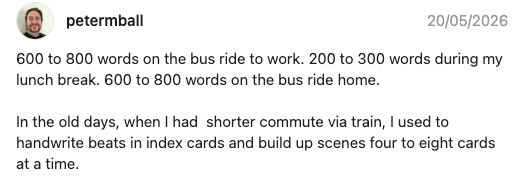
I typically expect to write between 1200 and 2400 words a day during my daily commute. As shown in the drafting heat map I posted a few weeks ago, those words are typically split between four or five different writing sprints, which largely correlate to the transit time in my two-bus commute to work and my lunch break.
I’ve been thinking about this because someone recently asked how writer with full-time jobs could publish four times a year. I’d recently posted my drafting heat-map, so I could reasonably break down wordcount and expectations in my answer.

Then came the question that surprised me: was I dictating, or carrying a laptop around?
For the record, I’m firmly team laptop. I’ve tried dictation a time or two, and it really isn’t my jam. My storytelling brain works differently when I’m putting fingers on a keyboard, and I’m way less socially anxious about being “seen” on the page compared to speaking out loud.
To me, laptops are a no brainer.
That said, I’m the guy who bangs on about infrastructure and writing awful lot, and it’s worth noting that my choice to cart a laptop to work everyday is predicated on building infrastructure that supports that choice.
Here are three important steps that really helped make my commute work as writing time.
LEARN TO TYPE
I touch type at a pretty decent clip – around 86 words a minute if I’m worrying about accuracy, but faster when I’m rough drafting and focused on getting a rough skeleton down. I don’t need to pay much attention to the screen while I’m typing, which is an advantage on a crowded bus when you’re potentially sitting at an odd angle.
This was my mother’s doing. When I first talked about writing for a living at age 10, my mother’s first response was “take typing classes” and she made sure I followed up.
Sending five years of highschool as one of three dudes in a typing class instead of doing manual arts (shop class, if you’re American) has paid off again and again in the thirty years that followed.
In terms of maximizing what little time I have to write when working full time, my typing speed is probably the biggest and best reason I can make things work.
If you’re angling to become a writer and you’re still a hunt-and-peck typist, the most beneficial thing I can recommend is putting aside your work in progress for a few weeks and investing in a touch typing course.
TEST, INVEST, AND ITERATE
Folks who’ve been following my blog for a few months probably recall the process of testing my writing methods when I first started work.
Was working on a laptop better than working on a notebook? I tried both, along with index cards, typing stories on my phone and tablet, and even used tools like Notion to see if they worked better. I’ve worked in Word, in Scrivener, and in Google Docs.
When I eventually settled on the laptop as my tool du jour, I set about maximizing my use of it. This meant looking at the days where I wrote less and asking myself why, then iterating from there. I figured out my 2017 Macbook air (weighing in at 1.35 kg or 2.96 pounds) was a better choice than the newer-but-heavier PC laptop that technically has more grunt. (1)
Analysing patterns suggested that sometimes I wrote because I was stuck, but other times the barrier to entry was pulling my laptop out of a crowded backpack, which wasn’t easy when buses were packed.
That seemed an illogical reason to stop writing, so I invested in a smaller laptop bag where the whole side panel opened. I could sit on my lap, unzip, and the computer was ready to go. It meant carrying a second bag for my lunch, but also resulted in a lot more writing getting done.
As an aside: I’ve been watching the commentary around the new MacBook Neo with interest over the last few months, since lots of folks decry its comparative lack of memory and power when stacked up against other Mac Laptops.
To my amusement, the Neo has more memory and power than my Air, and will probably be my replacement when the ten-year-old laptop finally stops running the handful of programs I need it to run.
EMBRACE PRODUCTIVE INEFFECIENCY
The public transit route I take to work isn’t actually the most efficient path, according to my local translink app. Technically speaking, I could shave 10 to 15 minutes off my journey by catching a train into the city and jumping on an express bus that stops right outside my work.
I used that route for a few months after I moved, and so decided against it.
For one thing, the connections between bus and train proved unreliable.
For another thing, both bus and train were inevitably crowded, especially when Brisbane train workers began ongoing industrial action earlier this year.
The route I take is a little less direct, but it’s on two buses that are very rarely crowded and always connect on time. It’s inefficient for getting to work, but it maximizes my writing efficiency by ensuring there’s somewhere to sit.
Also, turns out taking the extra ten to fifteen minutes is just fine when I’m writing. That’s another couple of hundred words when I’m really on fire.
Most days, that trade off is definitely worth it.
PROCESS SUBJECT TO CHANGE
Of course, all of this is just the latest iteration of my process when it comes to writing around a day job. In the past I’ve used other strategies: going to work two hours early and writing in a food court, for example. Or writing a short-story a week on my eight minute train ride to work by using index cards to handwrite a single beat of a story every trip in.
What I’m doing now is what works best for me, in my personal circumstances which involve a long commute, a job with minimal brain-drain compared to my prior gigs, and a work that allows me to adjust my start and finish times to make maximum use of the public transport options that suit my process.
I can’t guarantee my process will look the same a year from now. Every new job kicks off a new round of iteration and testing, figuring out what works best.
But I am certain that I’ll have a process that works around the day job, and gets a certain baseline level of activity done. I’ve written books under adverse conditions before, and managed a story a week while working one of the worst day-job gigs of my life (which is saying something).
As I wrote earlier this year, a big part of figuring out how to write around a day job is focusing on fixing one thing at a time.