
When we moved to the new house back in December, one of the first things we culled before packing was cookbooks. At the time, I thought it was because everything we cooked tended to be taken from blogs rather than books, and now lived in my Obsidian set-up (originally an evernote set-up, but I’ve been thinking more open source of late for various reasons).
Anyway, it turns out wrong. I don’t cook out of notetaking apps anymore. These days, the majority of the new recipes we try in our household don’t come from cookbooks or food blogs – they were coming from Tiktok and Instagram reels.
Which meant, surprisingly, I’d drifted towards more analogue tools without realising it.
Reels and TikToks suffer the problems of many social media platforms, which is a complete lack of useful archiving tools that make revisiting things easy. You can like and save a recipe you find this way, but there’s no easy way to search or categorise what you’ve liked.
Which meant over hte last year or so, my recipe base increasingly became quick notes scrawled into a dedicated Bullet Journal Project, jotting down the key details before letting the reel scroll on.
Turns out, this had a few benefits. For one thing, whenever my spouse asked what was in the meal we just ate, I could photograph the notes and send them. When I started experimenting with recipes, or tried something new, I could make notes about what worked and what didn’t.
Plus, I could personalise the workflow over time.
We make a lot of baked oats for breakfast, for example, and the recipes are frequently multi-step processes. In practice, it largely amounts to the same three things: gather a list of dry ingredients, gather a list of wet ingredients, mix them together in that order and bung ’em in a pan.
Lots of the original recipes we looked at used multiple mixing bolws, but we started just doing everything in the one bowl and had zero problems, so now every baked oats recipe we try is basically variatons on the initial theme. One bowl, one brownie pan, dry ingredients, wet ingredients, mix and bake.
This worked really well for exactly three months, whereupon I moved to a new bullet journal but found myself referring back to the old one whenever it was time to cook. I kept telling myself I should copy those recipes into Obsidian, like I used to use, but I knew I’d miss the notebook.
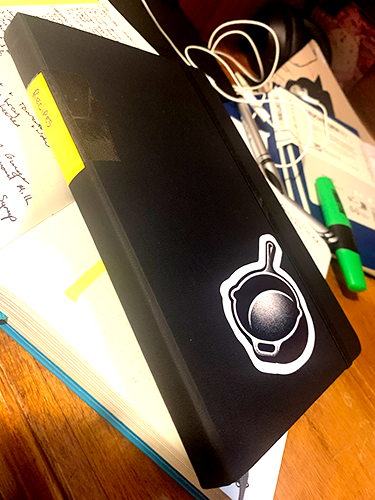
So I went the analogue route, and bought a dedicated recipe notebook. I still log the new recipes in my buju as they come along, but if something gets cooked more than once, it eventually finds itself in here.

If I’m honest, I don’t hate this development. My childhood memories were full of paging through the handwritten recipe books my family had accumulated. Documents that used space and formatting differently, engaging in shorthand where traditional recipe books might have used more formal language and layout (see, also, The Most Useful Format Isn’t Always The Most Familiar for a look at how the structure of a recipe can be reworked in interesting ways).
It also serves as an interesting redrafting process, where the bujo recipe is the R&D phase where I see what’s necessary, and the recipe journal version streamlines the most important notes and insights.
Leave a Reply