
When talking back list, one of my core lessons is you have time to capture the reader. Often that means you can sell them a book months or years after they first encounter you, and if you do things right, you can sell them books at full price instead of constantly discounting.
Here’s a little case study of what that looks like, drawn from a recent purchase.
PHASE ONE: THE LEAD
I first encountered the Phillipine’s based romance author Mina Esguerra while working for BWF a few months back. Their work had an interesting hook that captured me immediately (Esguerra is the founder of Romance Class, a grass-roots collaborative movement that’s basically built up the English language romance scene in the Philipine’s from scratch).
This was basically a lead event — I’d encountered the author, discovered some interest, but didn’t immediately want to go out and read their books. I was more interested in what Esguerra did than what they wrote.
But it did get me to a point of engagement — I attended their session at BWF — and convinced me to keep track of their work via their twitter feed.
PHASE TWO: WARMING THE READER
Long-time readers may remember that I loved their BWF session, which certainly stoked my interest in reading their work, but didn’t quite tip me over into buying a copy. Not least because funds were short at the time — I was in between my last BWF paycheque and my first paycheque from the writers centre — and romance is a genre I love, but definitely not my core reading genre.
In marketing terms, I was a warm customer. Interested, but not yet convinced the value of Esguerra’s fiction would be worth the opportunity cost of the purchase price and the time spent reading.
Readers often spend a lot of time in this phase. We’re distantly aware of countless books we might enjoy, but it’s not until there’s a surge of conversation we want to be part of, or great reviews, or personal recommendations from trusted friends that we finally break down and purchase.
Traditional publishing is great at building that value quickly, but it’s not the only way. Lots of indie author simply warm readers up gradually, putting out stuff folks are kind of interested in and talkinga bout interesting stuff on their socials, never quite making a sale but not doing anything to cut a kinda-interested reader off.
This process of warming a reader up is a slow, incremental increase in the potential value of a book until the opportunity cost ceases to be a barrier. There’s a lot of ways to do it ; short-term discounts can rewrite everyone’s opportunity cost calcuations, for instance, but it’s just as likely you’ll eventually put something out that hits the sweet spot for a reader’s interest.
Which leads me to…
PHASE THREE: THE FIRST PURCHASE
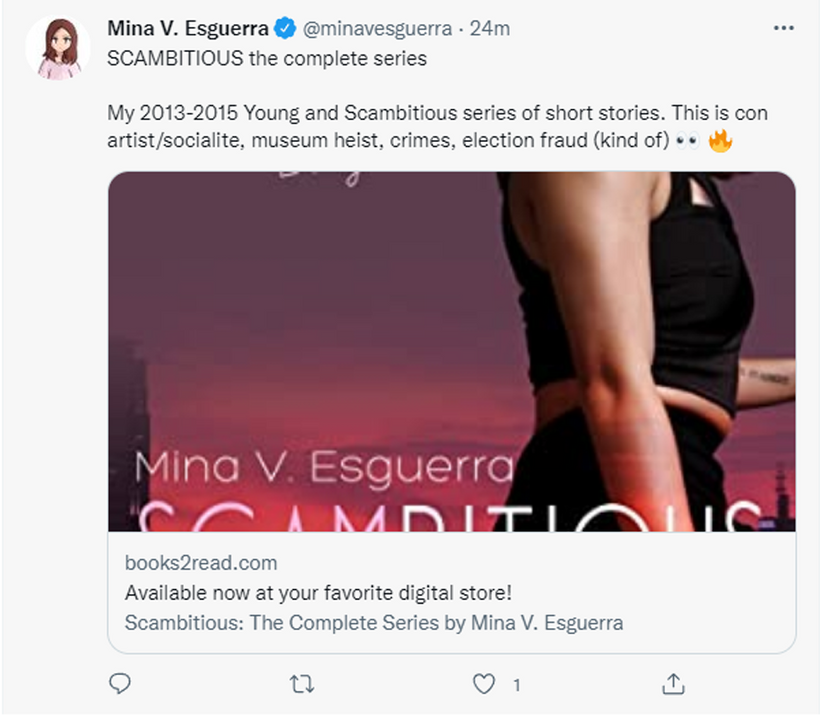
What finally tipped me over the line to purchasing my first Esguerra book? This tweet:

What tipped the value proposition in Esguerra’s favour wasn’t a price point, but the framing of these older works in terms that appealed to my interests. I’m very interested in series works and self-published short story models, and I’m a big fan of heist films and TV shows like leverage.
The book cost me $5.40 Australian, which is line with Esguerra’s other works, but it ceased being an obstacle because it hit a sweet spot in terms of value. Even if I dislike Esguerra’s writing, my $5.40 will not be wasted because there’s other sources of value in the book beyond the story.
It also coincided with a recent payday from work, and the arrival of my tax return, so I’m I’ve got a bit of a buffer in my impulse buys spending account. I’m primed to go from a warm lead (interested) to hot (paying money).
Total time to make the first sale from the lead time? Approxiamtely 12 months, although I’d been bubbling along with a vague interest that entire time. It was just the right combination of factors, many of which were outside of the author’s control, that finally tipped me over.
And, having tipped over and bought the book, I have a different data set to use when calculating in Esguerra’s other work. If I like what I’ve read, the next phase (superhot) could well be purchasing a lot more of her books, with much less time and effort required from her end.