
The Dailies

A few weeks back, I started picking up an old habit I’d left behind.

It goes like this: every morning, I tend to wake up and work my way through a three-page planning document designed to help me frame my to-do list. It started out as a bunch of notes from Todd Henry’s Die Empty, then gradually evolved to include little bits and pieces from other routines I’d trialed (such as this one at the bottom of of Tobias Buckell‘s bullet journal post).

It’s a useful document that walks me through four major areas of focus with dot point prompts to guide my planning: what’s important to me today? What am I trying to change or progress? Who will I talk to and what do I value about them? What are the things that need to be done, and the things I may have forgotten?

It makes for a nice little ritual to work through over coffee, and generally gives me about two pages of detail to guide my activities for the next twenty-four hours. I set it aside when I left office work behind and my focus narrowed, but as I move into the tail end of my PhD, I’m starting to accumulate more focus and split my focus a lot more than I’d like.

Ergo, I’ve busted out the list once more, and started a dedicated notebook I’ve dubbed The Book of Days.

Right at the end of the process there’s time and questions set aside for dreaming: In an ideal world, how would you spend your days? What are the ambitions you’ve let slide lately? What are the things you want to achieve before you leave this earth? What ambition have you need neglecting because you don’t know how to begin?

It’s interesting, answering these questions every day. My ideal day is never consistent, but are both recurring patterns that emerge over time, and weird interjections that crop up when I feel like certain parts of my life has been ignored.

And, slowly, I’m starting to develop a list of dailies. The things that I want to fit into my day, every day, in order to take steps towards the life I’d really like to be living.

  • Work on my current creative project
  • Write a short burst of words on my thesis/non-fiction process
  • Snuggle my partner
  • Walk for a half-hour and stretch, to prevent the back pain that’s been creeping up on me as I age.
  • Post a little process image over on instagram, and tell a story to go with it.
  • Blog about something interesting from my process notes or reading
  • Learn something new or refine a process/system so it works a little better
  • Write a second of my weekly newsletter, so I don’t have to find an entire block of time to write the full thing on a Tuesday/Wednesday.
  • Go out into the world and drink a cup of coffee somewhere interesting, or have an interesting conversation.
  • Cook something tasty.
  • Do something that may help Brain Jar Press sell more books (because, honestly, I have a number where the press is a success, and right now I’m still building towards it).

Or, if I’m feeling the need to be pithy about it: Make something. Learn something. Love well. Share something with the world and build for the future you want.

Leave any one of those steps out and my life starts feeling a little off-kilter, but get a little done on each and I go to bed feeling like everything is doing okay.
Lull

Tonight’s a moment of respite, I think, amid the pell-mell rush of the last few weeks. And for all that it’s been a good kind of rush, full of new jobs and new words and ticking things off the metaphorical to-do list, I’m kind of glad to be easing off the accelerator a little. I’m currently sitting my study with a snifter of port, my belly full of well-roasted vegetables, and my head full of stories that I’d really like to write in the near future.

It’s a pleasant kind of feeling, one that’s been all too scarce over the last eight months, and it’s rather nice to be looking at things I could do instead of panicking about the things I haven’t yet done.

#

So, yes, an update. Where shall we begin.

As I mentioned in my last post, I disappeared down the Rabbit Hole over the weekend just gone. It was a deranged and foolhardy exercise, conceived by my new boss, where a group of writers gathered together for three days and tried to write 30,000 words each. I wrote no-where near that many, nor did I expect to, but I still emerged from the weekend with 16,000 words under my belt and a substantial head-start on the next few installments of Flotsam.  I’ll be off to continue work on the draft once this blog post is done, forging ahead into this brave new world where I do not have to live in fear of deadlines.

I’ve discovered magical things happen when you do not fear your deadlines. That Douglas Adams quote about deadlines making pleasant noises as they whisk past isn’t all its cracked up to be, largely because missing deadlines just makes you stupid and slightly worthless, regardless of how nice the editor is about things. And writing isn’t one of those activities that gets better with misery and late-night cram sessions. Getting things done ahead of a deadline means the story you turn is much more likely to resemble the story you thought you were writing, for example, and you’re actually permitted to email your editor without starting using the phrase look, I’m really sorry about this, but…

There are other things being written too, quietly and in the short cracks of  free time created by the new job. Catching the train to work means I can scribble down a page or two before work, and getting a lunch break is good for another couple of hundred words. I started a new short story today, something that may be a strange kind of love story, and I suspect it may be the first love story I’ve written that actually has a happy ending. My plan is to write the entire thing on my morning commute, in one of the moleskins I was given for Christmas and never really got around to using because they were too nice for scribbled notes, and there shall be trains and people who think they know better than they do and murdered donuts who suffer excruciating deaths.

(Of course, someone at worked asked about the third Miriam Aster novella today, to which the only answer is look, I’m really sorry about this, but…)

Which brings us, I suppose, to the new job.

I’ve been somewhat coy about mentioning this online, largely because the sensation of having a regular day job that I like and enjoy is a remarkably foreign experience. The short version goes something like this: three days a week I work as a project manager for a community arts project run by the Queensland Writer’s Centre, which is this very odd cross between working a meaningful, engaging, rewarding job that I really enjoy and getting to catch up with a bunch of writer-type people I usually only encounter at writers festivals, workshops, and conventions. That I get to work in offices located at the State Library, above a cafe with decent coffee and a non-mallspawn bookstore is icing on the cake.

I’m three weeks into the contract, and I’ll admit to being slightly nervous about going in this morning. I love the job dearly thus far, but i’d just spent three days in the QWC offices belting out words for the rabbit hole. Surely, I thought, this will be the day I resent the fact that I can’t just stay home and write. 

Turns out, no, it wasn’t. Not even a little. And man, I tell you, that realisation was very unsettling.

#

Okay, some random things.

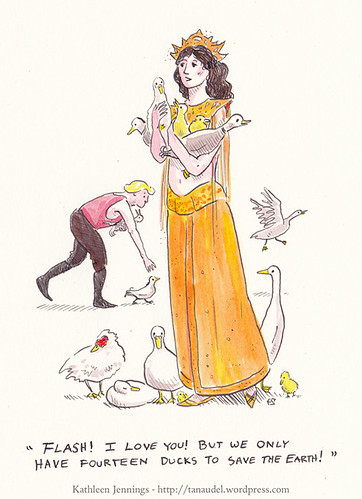
Kathleen Jennings draws strange and curious things with surprising regularity, and if you’re not following her blog then you’re really missing out. The Dalek Game, in particular, has been one of the highlights of my year. Last week Alan Baxter and I used the medium of twitter to produce this startling rendition of Flash Gordon, Dale Arden, and the Fourteen Ducks who can Save the Earth. Go and check it out – odds are, if you’re reading this blog, you’re going to enjoy the experience. Personally, I think the image answers any questions I ever had about why twitter was a worthwhile place to spend time.

Stephen Dedman’s The Art of Arrowcutting is a remarkable novel, one that’s done a remarkable disservice by it’s cover-blurb given the way the urban-fantasy/noir genre has shifted since the book was first released. I suspect it’s not a book I’d recommend to everyone, but also suspect that those I would recommended it to would come to love it with a kind of fierce and unholy joy. It is, however, almost certainly a book for writers to read – it was recommended to me as a book with phenomenal, Wuxia-influenced action sequences in prose form and it utterly delivered on that recommendation. It also makes me wonder why in hell it’s been five years since someone last published a Stephen Dedman novel, because there really should be more of them floating around in the world.

And: Apex Publications, a company I have a great deal of affection for, have recently had interest Diamond Distributors about carry the Apex range of books and short story anthologies in stores across the USA and the UK. Taking advantage of the opportunity means Apex needs to shift their business model away from short print runs, so they’re currently crowd-sourcing the funds they need on peer-backer.